
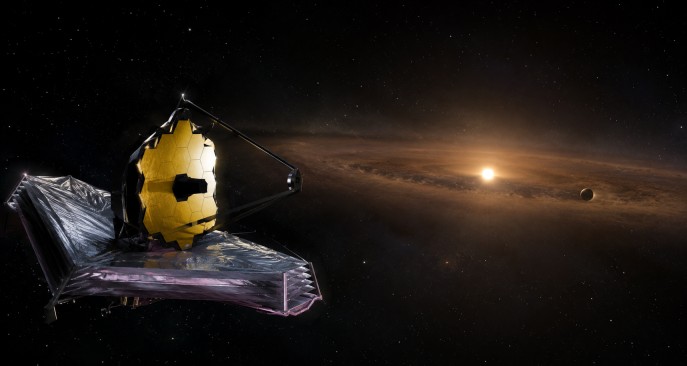
Astronomers have made a significant discovery using NASA’s James Webb Space Telescope, identifying an exoplanet named Beta Pictoris d within the Beta Pictoris star system. This finding adds a third giant planet to a planetary system already under extensive study. The newly detected planet is notable for being discovered through the unique chemical signature of its atmosphere, rather than through direct imaging, which had been the method for identifying the two previously known planets in the system.
The discovery came as a surprise to scientists who were utilizing Webb’s Near-Infrared Spectrograph (NIRSpec) to study another planet within the same system. Through their analysis, researchers were able to confirm Beta Pictoris d’s existence by examining its atmospheric composition and motion, identifying the presence of carbon monoxide, water vapor, and methane. This breakthrough was achieved as the planet orbits within the system’s bright debris disk, a feature that had previously obscured it from conventional imaging methods.
Located approximately 63 light-years from Earth, the Beta Pictoris system is an invaluable site for studying planetary formation and evolution, given its relatively young age of about 23 million years. Scientists have estimated that Beta Pictoris d is at least twice the mass of Jupiter and orbits its star at a distance similar to that of Neptune in our own solar system. This discovery not only enriches our understanding of the Beta Pictoris system but also highlights the potential for finding other hidden planets in similar environments.
The identification of Beta Pictoris d marks a milestone as the first time an exoplanet has been discovered mainly through moderate-resolution spectroscopy. This technique, demonstrated by the James Webb Space Telescope, opens new possibilities for locating planets that reside in dusty environments, which are typically challenging for traditional planet-hunting methods. Researchers are optimistic that this approach will enhance future exoplanet searches throughout the Milky Way, offering a promising avenue for uncovering more hidden celestial bodies.