
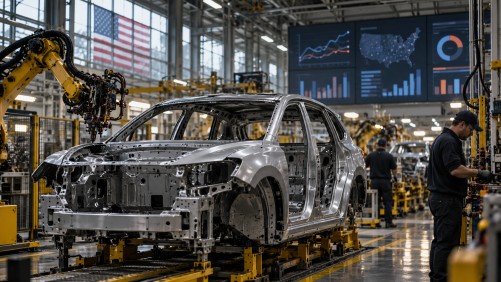
Uncertainty in U.S. electric vehicle (EV) policies is causing significant challenges for automakers, sparking concerns about the industry’s investment and production plans, as well as its competitive edge. The U.S. has imposed tariffs exceeding 100% on Chinese EVs and introduced restrictions on China-linked automotive software and hardware, primarily due to trade and data security issues. However, experts caution that these protectionist measures may not effectively bolster domestic manufacturers without a coherent, long-term industrial strategy.
Changes in government incentives and fuel economy standards during President Donald Trump’s administration have further compounded the uncertainty for automakers. As a result, some U.S. companies have scaled back expansion plans, delayed new EV platforms, or reconsidered production targets, given the long-term nature of investments that typically take five to ten years to yield returns.
Chinese manufacturers, too, are wary of entering the U.S. market amidst policy unpredictability. Companies like BYD have indicated reluctance to sell passenger vehicles in the U.S. under current conditions. Despite these challenges, the U.S. continues to be an attractive market for affordable electric vehicles due to the advanced battery technologies and cost-efficient production capabilities developed by Chinese manufacturers. These factors present potential opportunities for cooperation in future U.S.-China trade negotiations.
President Trump has suggested that Chinese automakers might be permitted to manufacture vehicles in the U.S. if they establish factories and create local jobs. Nevertheless, several American automotive industry groups advocate for maintaining restrictions on Chinese manufacturers. While broad restrictions on Chinese automakers are expected to persist, selective partnerships in battery technology and manufacturing could continue where there are commercial advantages.
Some U.S. companies are already exploring selective collaborations with Chinese firms. For instance, Ford is partnering with Chinese battery manufacturer CATL on a battery facility in Michigan, where CATL provides technology and related services. This reflects a trend where strategic alliances might be pursued despite overarching trade tensions, provided they offer mutual benefits.