
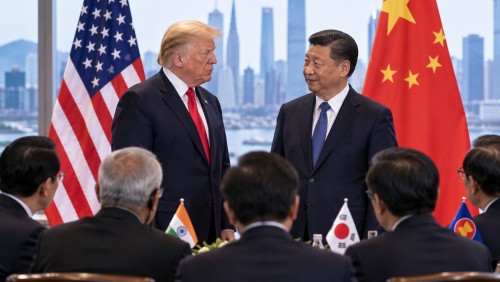
US President Donald Trump and Chinese President Xi Jinping are set to meet, with significant implications for Taiwan amid ongoing trade and economic discussions. The meeting is being closely monitored by US allies in Asia, particularly Taiwan and Japan, due to concerns that any shift in Washington’s stance on Taiwan could impact regional stability.
Officials in Taiwan have been actively communicating their concerns to the US prior to the summit, anticipating that President Xi will broach the issue of Taiwan during talks. Washington has historically upheld a policy that acknowledges China’s claim over Taiwan without endorsing it, while maintaining unofficial relations and defense cooperation with the island. However, President Trump has not explicitly stated whether the US would defend Taiwan in the event of a Chinese military action.
Japan is also paying close attention to the upcoming discussions. Japanese officials have emphasized the importance of maintaining the established diplomatic language concerning Taiwan to avoid escalating tensions in the region. They are seeking to facilitate communication between Japanese Prime Minister Sanae Takaichi and President Trump before the meeting.
A crucial aspect of the US-Taiwan relationship under scrutiny is the ongoing arms sales. A proposed arms package for Taiwan, which President Trump once suggested could serve as a bargaining chip in negotiations with Beijing, remains pending approval. China has consistently opposed US arms sales to Taiwan, viewing it as part of its territory, and has urged Washington to consider Beijing’s perspective on the matter.
While the primary focus of the Trump-Xi meeting is expected to be on US-China economic relations, Taiwan’s status remains a pivotal concern for US Asian allies. The potential impact on regional security and global semiconductor supply chains underscores the broader significance of the Taiwan issue in the context of US-China diplomatic engagements.