
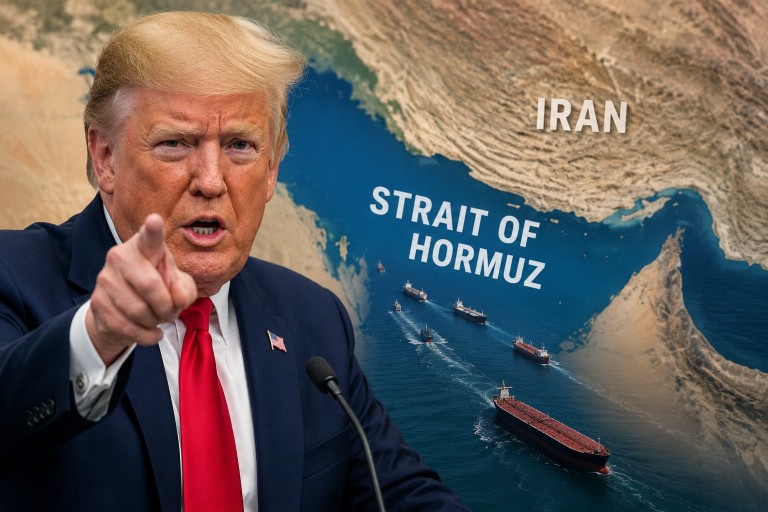
In a bold statement that has added tension to the US-Iran conflict, President Donald Trump announced plans to potentially declare the Strait of Hormuz as “a territory of the United States.” This announcement, made during a speech in New York on Friday, underscores the struggle Washington faces in reaching a resolution with Iran. Trump suggested that after a victory over Iran, the United States would soon make this declaration, asserting that the US already exercises control over the strait through a blockade.
The Strait of Hormuz is a critical maritime passage, with nearly 20% of the world’s seaborne oil supply passing through it. Located between Iran and Oman, the waterway’s importance is underscored by its current closure, a result of military actions by the US and Israel against Iran. However, it remains uncertain if Trump’s remarks are indicative of a shift in official US policy or if they were merely intended to serve as a rhetorical stance.
Iran has firmly rejected these threats from the US. Deputy Foreign Minister Kazem Gharibabadi emphasized that Iran would not succumb to American pressure, maintaining that any decisions regarding the strait remained under Iran’s jurisdiction. Moreover, Iranian Foreign Minister Abbas Araqchi clarified that while there are messages being exchanged via intermediaries like Qatar and Pakistan, these do not amount to formal negotiations with the US.
Tehran has set forth several conditions for reopening the strait to shipping, including demands for compensation for damages from the conflict, the lifting of imposed sanctions, and the release of Iranian assets currently frozen. The ongoing conflict and subsequent shipping disruptions have led to increased fuel prices, further impacting consumers. President Trump defended these price hikes, arguing that the cost is justified to prevent Iran from acquiring nuclear weapons.
The unresolved standoff over the Strait of Hormuz is raising alarms about global energy security and its broader economic repercussions. As the situation remains tense, the international community watches closely, aware of the potential implications for worldwide oil supply and geopolitical stability.