
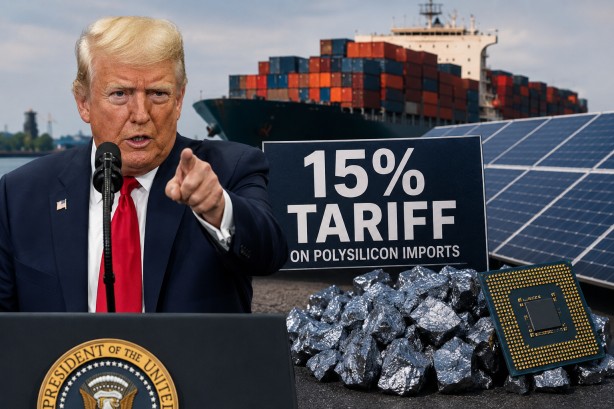
President Donald Trump has initiated a 15% tariff on imports of products containing polysilicon, a crucial material for semiconductor and solar panel production, which will be enforced starting December 4. This move is part of an effort to bolster domestic manufacturing and lessen dependency on China, which currently dominates the global polysilicon production market.
Polysilicon, a highly purified form of silicon, plays a vital role in creating semiconductors used in artificial intelligence systems and data centers, as well as in solar cells and panels. Alongside the tariff, the new policy sets minimum import prices, including $21 per kilogram for polysilicon, $100 per kilogram for polysilicon ingots and wafers, $0.22 per watt for solar cells, and $0.38 per watt for solar modules and panels. These measures aim to enhance the competitiveness of U.S. polysilicon production and fortify critical supply chains that are pivotal to the country’s economic and national security interests.
China, the foremost producer of polysilicon, has condemned the tariff, accusing the U.S. of exploiting national security concerns to hinder Chinese enterprises and cautioning that heightened protectionism could lead to trade disruptions between the two nations. Despite this, the U.S. government is forging ahead, with plans to introduce incentives for companies that invest in domestic manufacturing facilities related to polysilicon.
Currently, the United States hosts two major polysilicon production plants run by Hemlock Semiconductor in Michigan and Wacker Chemie in Tennessee. These facilities stand to benefit from the new import tariffs and potential government incentives aimed at boosting domestic industry. Meanwhile, China continues to experience robust growth in exports, particularly in electronics and products associated with artificial intelligence, reinforcing its position in high-value manufacturing sectors.